
Essays and catalogue texts, 1997 - 2013:
The Concrete Hour
Where Where Art Space, Beijing
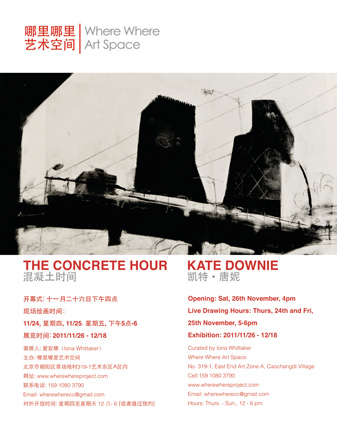 Kate Downie works on the principle that no space is denied the right to be poetic. Her approach surpasses hackneyed musings on ‘urban poetry’ that find beauty and contemplation underlying the noise and impersonality of contemporary cities. Since her 1989 performance piece amid ‘la circulation’ in Paris, her practice has shown an unusual fascination with road junctions, borders, barriers and the spaces between buildings which human beings habitually negotiate and traverse. To the artist’s mind and medium - here a live drawing in charcoal and ink - the physical experience of a city entails its own artistic language. Like a huge pulse, its iambic meter is advanced and disrupted by myriad wheel movements, neon lights and the rhythm of pedestrian strides marking endless small migrations. Arriving in Beijing from her native Edinburgh last year, and having returned this autumn, the artist meets a city whose fabric spans a rupture between the teeming, irregular accumulation of human life and possessions in narrow hutongs and the overarching, regular forms of skyscrapers and apartment blocks erected beside vast roadways. In Beijing, she finds, there is no ‘middle scale’ such as people are accustomed to in Europe: only cramped vs. consuming spaces in which the public appears as a now-outsized, now-dwarfed cast.
This live drawing on the walls of Where Where Art Space is Downie’s response to the opposing environments in which we find ourselves in Beijing. Against their separation in reality, she literally draws together a hutong crossing and a multi-lane junction so as to place them on the same plane, inverting their relative scale and ours in relation to it. The drawings are directional, synonymous with the rush and pause between architectures. Thus, the two sides of Beijing’s urban landscape are made to face each other. Poetry need not solidify images, but can exist alongside them to express instances and shifts. The visual artistic language witnessed here is temporary, awaiting erasure even as it unfolds.
Iona Whittaker
凯特·唐妮 (Kate Downie) 认为任何空间都具有诗意的权利。
空洞的“都市诗歌”试图在现代都市的喧哗和人际的冷漠背后寻找美与沉思,唐妮的创作手段显然超越了这种无病呻吟。1989年,她在巴黎呈现了行为作品《流量》(‘La Circulation’ ), 她的实践一直以来展现着交叉路口、城市边境、关卡和建筑之间缝隙的独特魅力,向我们敞开了人们日常交涉和穿越的空间。艺术家用墨汁和炭笔进行现场绘画,呈现她的思考和所使用的媒介,把这个城市的身体体验化作城市自己的艺术语言。都市抑扬顿挫的韵律如同弹跳有力的脉搏,在滚滚车轮的喧嚣、霓虹灯、行人的来来往往和漫无休止的迁移中此起彼伏。凯特·唐妮去年秋天从家乡爱丁堡来到北京,今年秋天又再一次来到这个城市。艺术家面对的这个城市中,狭窄胡同中生活的拥挤和繁闹与宽宽大路旁摩天大楼和公寓的秩序感融合在一起。艺术家发现,北京不存在欧洲人们习惯的“中等规模”,要么是狭小的生活空间,要么是庞大的消费场所,这里的人们好像一群时而扮演巨人、时而扮演侏儒的演 员。此次艺术家在北京哪里哪里艺术空间的现场壁上绘画呈现回应的正是北京这个我们生活于斯的环 境。唐妮把胡同和公路交叉路口画在一个空间维度里面,打破了它们在现实中的分裂,颠倒了它们与我们的相对关系。这些画带有指向性,还与建筑物之间的行笔和停顿有着同义关系。北京都市风景的双重面孔便出现在艺术家的画作中面对彼此。她笔下的诗画并非呈现凝固不动的图像,而是与图像并存,表达一种距离感和转换关系。我们见证的这一视觉艺术语言具有临时性,等待着“昙花一现”的时刻。Time Out Beijing: Kate Downie
ARTslanT: Shows not to miss
ARTLINKART: The Concrete Hour - Kate Downie Solo Exhibition
LumDimSum: Kate Downie's "The Concrete Hour" Solo Exhibition
CAFA ART INFO: The Concrete Hour: Kate Downie Solo Exhibition Unveiled at Where Where
Herald Scotland: Kate Downie takes art on to the streets of China
Where Where Art Space: The Concrete Hour: Kate Downie
Giles Sutherland: Kate Downie: The Concrete Hour
Kate Downie New Work
Scottish Gallery
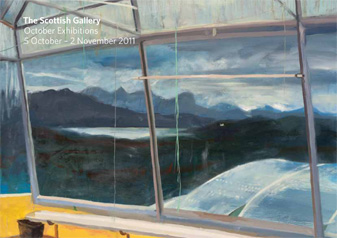 In the village of Achiltibuie there is a former Hydroponicum, a huge experimental 'light-box' built to grow fruits and vegetables with water, nutrients and light. Now disused and in disrepair, I was allowed to use it as a temporary studio and lookout over the beautiful wet lands and changing sea-light of the Summer Isles. There is something very attractive about this 20th century dream of overcoming poor soil, high winds and northern climes to grow exotic produce. Diverse attempts at self-sufficiency have echoes in traditional crofting, and the abandoned Citrus Rooms are the modern equivalent of the abandoned croft. Plastic,
vinyl, wood and glass, nylon string and optimistic yellow paint; all set to the distant view of the unchanging, indifferent and beautiful mountains of Sutherland.
In the village of Achiltibuie there is a former Hydroponicum, a huge experimental 'light-box' built to grow fruits and vegetables with water, nutrients and light. Now disused and in disrepair, I was allowed to use it as a temporary studio and lookout over the beautiful wet lands and changing sea-light of the Summer Isles. There is something very attractive about this 20th century dream of overcoming poor soil, high winds and northern climes to grow exotic produce. Diverse attempts at self-sufficiency have echoes in traditional crofting, and the abandoned Citrus Rooms are the modern equivalent of the abandoned croft. Plastic,
vinyl, wood and glass, nylon string and optimistic yellow paint; all set to the distant view of the unchanging, indifferent and beautiful mountains of Sutherland.
In both Sutherland and Perthshire – trees matter. Big empty moorland, trees clinging in bundled overgrown gangs about an empty homestead or a summer cottage, nature taking over from human design; little forests in the making.
I name them Arboreta Domestica.
Kate Downie 2011
The Scottish Gallery
Coigach Community Development Company
Bridging the Gap
Pittenweem Arts Festival 2011
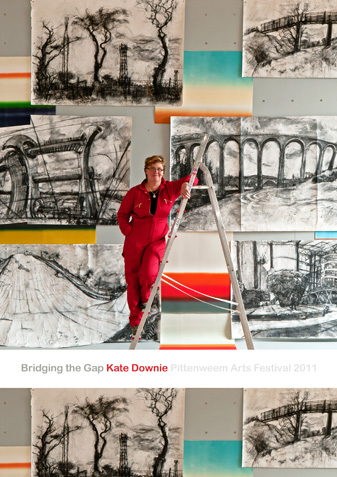 What is the difference between a sketch and a drawing? Perhaps a sketch is a quick way of working things out, a few marks made as an initial visual response to a place, an idea set out before it flies away.
Most of the works here are not sketches but they are drawings. Made within the act of fully immersive open gazing over many hours and days, often on site, these drawings could be seen in their relationship to art as investigative journalism is to writing. In this form of intensive picture making, they hopefully transcend to a state of poetry, where, to quote Giles Sutherland, they convey “a deeper wider experience” of place.
This decade of drawing has also collected the detritus of experience with it; mud, rust, grass stains, each paper carries more than charcoal. The act of rolling up , flattening out, dragging along the ground, pinning up , falling down, being trod on … these works bear witnesses to the act of ‘being there’, and this is what makes the artist reluctant to enclose them in a glazed box. Munch is quoted with saying that art is not what you see but what you saw. In ‘Bridging the Gap’, the memory of what the artist saw has been tenderly transposed into a new series of colour blend monotypes made specifically for this event by the artist in collaboration with Alastair Clark at Edinburgh Printmakers. Each of the prints is a stratification of the colour memory of these feats industrial or recreational engineering, the drawings bound by journeys and discoveries across Scotland. Together on the north wall of the old Hall in Pittenweem, they become a poem to the structures and memories of our lives in this country, hopefully bridging the gaps in perception between narrative and abstract art as well as between old technologies and new in our commonly held landscape.
Kate Downie August 2011
Kate Downie: The Coast Road Diaries (Catalogue text)
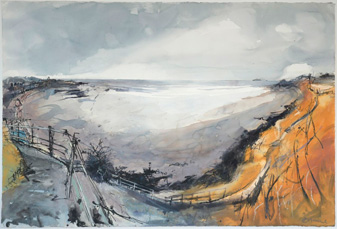 Over the past two years or so, the artist, Kate Downie, has travelled to a number of coastal locations in Scotland – and one in Ireland – to pursue a project which she has named The Coast Road Diaries. Each of the places she has visited has resonated with significance, either on a personal or professional level, or both. Discussing the project, Downie has observed that
“… the overall project is based on a collection of journeys and short residencies,” adding that “… through the keeping of notebooks, film-making, photography and drawing along the way, ultimately hope to present a personal art-history through this new work …”
The traditional idea of a diary may connote the lifestyle of a busy executive, or a leather-bound volume full of secrets or a planned and scheduled personal life. None of these applies to Downie’s project; this is, instead, more of a notional diary freed from logical, sequential chronology and linear temporality. It is a framing device which allows the temporally fragmented, spatially and geographically dispersed project to gain some kind of coherence, a form, if you like, of poetic or artistic licence. Downie herself explains this approach:
The exhibition represents more of an idea of a diary than the actuality, that word ‘diary’ being used to convey the temporal and experiential nature of [my] own artistic development. The objective is to explore the connection between pictures and words, but more importantly, the revelations experienced by personal research into places, persons and influence.
The diary is, therefore, more of a metaphoric than a literal device and as such has a long history in art, film and literature. The literary diary and the road movie, although distant cousins, still have some common elements and it comes as no surprise to learn that some years ago Downie, with her partner, Michael Wolchover, made a short film, Driven (2001), which explores some of the themes in her work relating to Slains Castle on the East Coast of Scotland near Collieston, one of the locations visited in her present project. In many ways, The Coast Road Diaries is an extension of some of the earlier ideas explored here.
The Coast Road Diaries focuses on a number of well-known living and near-contemporary artists; and on a number of specific coastal locations. The choice of artist has been determined by a number of complex factors. The artists – Wilhelmina Barns-Graham (1912–2004), Muirhead Bone (1876–1953), Joan Eardley (1921–1963), Marian Leven (b.1944), Bet Low (1924–2007), Archie Sutter Watt (1915–2005), Sylvia Wishart (1936–2008) and Frances Walker (b.1930) – are all well known figures in the world of Scottish art. Barns-Graham, Bone and Eardley, in particular, have reputations which extend well beyond Scottish shores. Undoubtedly, all have profoundly influenced Downie’s approach.
Giles Sutherland from Kate Downie: The Coast Road Diaries, The Scottish Gallery 2009
Contrasting visions show why it's always better to focus (The Coast Road Diaries)
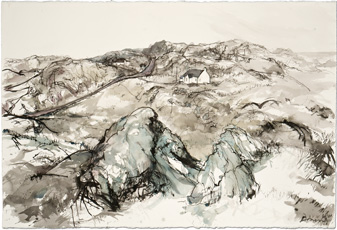 Kate Downie's project, The Coast Road Diaries, began more than two years ago with the aim of revisiting coastal areas of Scotland already familiar through the work of other artists and reinterpreting their vision.
The result is an extraordinarily powerful show, fresh and vital. The luminous orange sky in Wilhelmina Barns-Graham's January Sea finds an explicit echo in the ochre of Downie's dramatic ink, pastel and watercolour drawing The Coal Coast, Kinghorn. Elsewhere, the subtle juxtaposition of the late Frances Walker's ink drawing Shore Pool, Achmelvich with Downie's The Wednesday Road emphasises just how much the latter artist is indebted to the former.
Such influence extends not only to subject matter and technique but also to a disciplined way of looking at the world.
Similar observations can be made in respect of Joan Eardley's influence on Downie. The results dispel any doubts about a mere reiteration of Eardley's vision, for works such as The Watchie Path and a series of monoprints of Catterline Bay (as seen from Downie's camper-van) carry the subject matter into exciting new territory which Downie herself terms "edgescape".
While Austen's approach is eclectic, Downie's is concentrated; and although stylistically their work differs enormously, the former could learn much from the latter about how to pursue a focused artistic goal.Giles Sutherland The Times, October 20 2009
The Sea Room - An Introduction
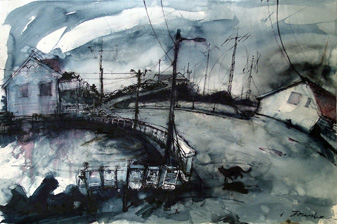 Radio Masts. One in every garden. Add discarded fishing gear and dramatic sea and landscapes and Kate Downie is in her element. The Sea Room is the result of Downie's seven-week residency on Ncrwegian island of Karmøy, one hour north across the fjord from Stavanger. It is a setting that catches Downie's eye being a rural but at the same time actively employed environment.
Downie's previous solo exhibition at The Watermill Gallery in May 2006 had two main themes, one exploring the remote landscapes communities of the north-west Highlands of Scotland, and the featuring built structures in the urban landscape with bold charcoal drawings of communication masts, gasometers and the Forth Rail Bridge.
The body of work in The Sea Room reflects her continuing exploration between human presence and a landscape that is swept by the full force of the elements of nature.
While the interrelationship of the whole town, harbour, land and sea is striking, there are many elements that would not normally be regarded as 'beautiful'. There are the elements of industry and rural detritus that often feature in Downie's work. The huge truck tyres used as fenders in the harbour, or the relationship between the road tarmac and the sea surrounding it. There are few road markings so roads are just ribbons of tarmac, like dark shipping lanes. The rain-slicked junctions large flat areas on the ground, reflecting the sky like open sea. In the past the sea was the road and it still is.
On visiting Downie's studio we were immediately confronted by a huge drawing - of a road junction in the coast town of Kopervik. This had been worked on in biting wind and rain. Downie adopts a sort of ‘bird’s eye' perspective but at ground level. She drew from seven different points to capture the whole junction in one sweep. This creates a view which does not exist to the eye. but is as it became imprinted itself on her consciousness - not as in a single photograph but as a living perspective.
Followers of Downie's work will recognise some of the works. for example in ink and watercolour, as coming from her hand. But other pieces represent a striving to explore new means of expression. Her recent series of Madrid monoprints have been a great success and she returns to this technique for a number of works in The Sea Room, allowing her to develop a freedom and fluidity.
In other works, wanting to capture the feeling of heavy 'liquid' of lead-grey skies and seas, Downie adopted a technique that involves pouring paint onto a surface. She explains: `There is a danger with ink drawing - people look at it and it gives a comfort "I know what it is". I want them to get out of the safety zone and look and think more about the picture. One way of doing this is to use opposing textures. Pouring paint gives a texture like pools of water, pools of light, interrupting the "understood" ink drawing. You couldn't get the same effect by painting onto the drawing. The paint has been poured onto a plastic sheet and then peeled off when dry. This gives it a puddle like surface. I was conscious of the northern latitude and the light - it was October/November and you were very aware of winter coming in, of the long, low, slanting light. When applied to the ink drawing this 'puddle' of colour gives the effect of light from somewhere else entering the scene - just as the paint has come from "somewhere else".'
This trip to Norway and the work surrounding it has been a leap in Downie's work. 'When I went to Norway, rather than it being an epiphany, I just let my art go - to a place where it became less restrained - me, but more so! I wanted to get behind the scene.' In The Sea Room she strips her work and the approaches that underlie it back to the essentials of an artist exploring how to use their mark-making, be it paint, ink, pencil or another medium, to get across the essence of what confronts their senses.
Having seen the body of work `in progress' in the studio, we discussed with Kate Downie the importance of recording the work as a whole in a catalogue. We felt this especially important as the large drawing, which is too big to exhibit in The Watermill Gallery, is going straight to the North Sea Project Exhibition in Edinburgh and Stavanger.
The Watermill Gallery would like to thank the Karmøy Council for their financial support in producing this catalogue and the growing band of collectors of Downie's work, both public and private, who made the May 2006 exhibition at The Watermill such a success, thereby paving the way for The Sea Room.
Kevin Ramage The Watermill Gallery, March 2008
from The Sea Room catalogue (available for purchase: £7 including P&P)
Beneath the surface
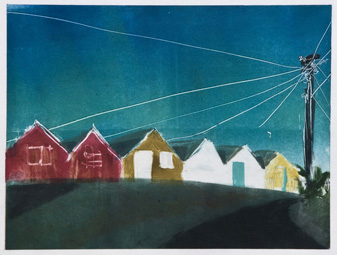 Refusing to be shackled by any one medium, Kate Downie's work - an exploration of our relationship with the land and sea - constantly demonstrates sensitivity and humanity
During Kate Downie’s formative years, an ocean separated her from the homeland she had never seen. In her child's mind's eye, despite never having seen any pictures of it, she knew exactly how it looked, right down to the rocks on the shore and the houses on the land.
"My father talked about Scotland a lot;” she recalls. “He had a wry romantic view of it, too, because by the time I was born, he hadn't actually lived there for a long while. He was a doctor who had trained as a neurologist in London, where he'd met my mother, a nurse. His speciality of neurology took him to North Carolina, which is where 1 was born.
"As a result, I had this visual mythology of Scotland in my head, particularly the north east of Scotland, before I'd even seen it. When we moved back to Aberdeen when I was seven, everything felt so new and this felt so exciting to me. If you grow up in suburban America where the oldest thing you see is a. wooden house that's 70 years old, the shock of the new is immense when a change like that happens.. I remember tiny details, such as the old-fashioned light switches and iron railings with their curly bits at the top with absolute clarity, even 40 or so years on."
Today, Downie's work as an artist still has that vivid clarity and immediacy of a child seeing a scene or an object for the first time and it is this quality, coupled with her immense skill as a draughtsman and a communicator, which attracts people to her bold yet sensitively executed drawings, prints, paintings and photography.
Jan Patience Homes & Interiors Scotland, October 2008
The Sea Room - Lines of Energy and Washes of Nature
The traveller sees what he sees;
the tourist sees what he has come to see.
G. K. Chesterton
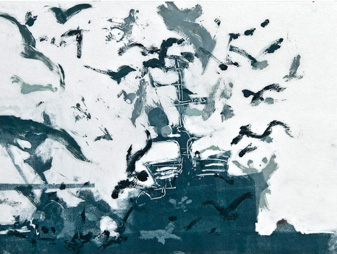 The best way to respond to land, town and seascapes, is to be responsive to those who live within them - people can catalyse the artist's activities. The island of Karmøy is fascinating destination; it is a large island with diverse landscape and several towns. The population is constantly exposed to the elements and thus enclosed within a strong sense of rugged pride and functional efficiency. Kate Downie's insatiable curiosity and boundless energy was of great help when penetrating any physical or psychological enclosures.
The artistic products arising from the residency can be viewed in two ways; what she has imported from home and what has been released by the alien experiences of this residency. So is Kate Downie a traveller, or a tourist?
There are many universal elements inherent to the coastal towns of Karmøy; they are working towns, hard working people who use things and are unafraid of the aesthetic consequences. Thus the coastal townscapes are not nostalgic, but elderly; the aesthetic of use has a logical haphazardness. Kate Downie has been perceptive of this; the frenetic lines of her townscapes encompass the energy of these seemingly isolated scenes. The boats and roads and harbours are still meeting deadlines, still producing both ugliness and beauty. For the tourist Karmøy is steeped in its Viking history, yet heavy aluminium industry and high-tech gas import systems also sit snugly on the Karmsund - the sheltered `Northern Way' to the east. Whilst, to the west the chill sandy beaches seem to have been strangely transplanted from the Seychelles, aesthetically if not climatically.
Therefore, it is where the town meets the land and sea that I find Kate Downie reveals much in her art. The townscapes have many strokes of the pen/pencil/brush, much like a Modigliani nude,
they bristle with energy. Whilst the land and seascapes allow more undisturbed washes of translucent wintry colour, a calmer fluidity overcomes the superficial tensions of the town. The flight of seagulls and a bobbing fishing buoy have perfectly natural lines of movement, whilst the cables and sharp angles of the town reveal other dynamics.
Norway has effectiveness in its language and in all forms of communication: what you see, or hear, is what you get. Consequently, an artist who is sensitive to the lines of energy not immediately visible will be much appreciated here.
Downie's technique of abstracting from the visual world is well known and much practiced in a country constantly renewing its Late Modernist practices, however the fluidity of her approach and the spontaneous creativity that Downie practises is rarer. I would like to thank our friends at Karmøy Council for aiding this creativity in a truly hospitable and 'European' way.
Kate says that this residency helped her to further discover her artistic self. I would propose that all forms of travel should expand the mind, if one is clever enough to leave one's everyday life behind, to leave habitual pre-occupations at home. But Oscar Wilde said it better; only the shallow know themselves.
Martin Worts Director Rogaland Contemporary Art Centre, Stavanger
from The Sea Room catalogue (available for purchase: £7 including P&P)
East
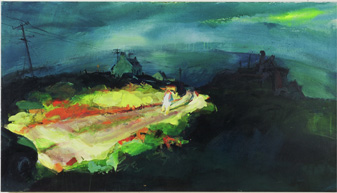 Slains Castle is a ruined mediaeval fortress on the rocky coast north of Aberdeen. Once a seat of the Earls of Errol, now half-forgotten, it stands on an isthmus at the end of a dirt road, guarding a small peninsula jutting out into the North Sea surrounded by cliffs. It is a wild place. Indeed it reputedly played. a part in the inspiration for Bram Stoker's Dracula. The castle occupies a strong defensive position and on this bleak headland it is also a reminder of how in the days of warfare and insecurity, the needs of defence came long before the claims of comfort. Kate Downie first went to this isolated spot when she was seven. She was born in the US many miles from the nearest coast, but her father was from Aberdeen and when the family returned to Scotland being taken on a visit to Slains Castle by her father was almost like a ceremony of initiation, a reintroduction to the sea, to her ancestral country and its troubled past.
Later, returning herself for the first time as an adult, she took her own children, deliberately choosing nightfall on a wild and windy day. This visit, occasioned by the commission to paint the major work From the Hills to the Sea was the inspiration for Driven, the short film that she has made which illuminates some of the themes in the rest of the work inspired by this striking place. In the film a car arrives at the castle, feeling its way down the tortuous track. The landscape is dimly lit by the fading light in the sky while the headlights of the car explore the semi-darkness as the mind explores our memories, illuminating brilliantly, but only fragmentarily (and therefore incoherently) the roadside and surroundings of the castle. And yet beyond that, by implication, this is also an exploration too of the past of the place itself.
Enigmatically, at the end of the film a strange couple appear framed against the dark stones of the castle, figures who also appear like ghosts in several of the large works. These she identifies as a mythical Earl and Countess of Errol. The family once owned all the land round about. They lost possession of it and only this small, historic part was later recovered. They are awkward, unhappy revenants, human fragments of the history of the place.
After her return to the castle on the visit that later inspired her film, she herself took a studio in the house on the peninsula and the work she did there forms the main part of this exhibition. The subjects of these works are the road down to the Castle, the ruin itself, the grassy peninsula behind it, the rocky stack, covered in sea birds, that stands out to sea beyond and the views from the peninsula looking inland towards the surrounding countryside. Several of the smaller paintings also relate directly to the making of the film. In these, too, we can see the yellow light of the car's headlights exploring the shadowy landscape. This is an effect that is also anticipated in a single earlier picture, Dreamtime at the Factory from 1996/7, which in subject matter stands outside this main group, but shares with it this idea of light exploring darkness. Otherwise paintings, drawings and monotypes altogether constitute a kind of inventory of the place and so the key works are the wide panoramic landscapes which summarise this inventory, Titanic Shores, and The Domestic Pastimes of the Earl and Countess.
In these the artist uses an almost spherical perspective. This is further emphasised in the latter picture by the vertical viewpoint that we take. It has the effect of placing the castle, the peninsula and the house that was the artist's studio at the very centre of the whole experience. We, and the ghostly Earl and Countess, are on the inside looking out at the world.
This is the link to the Forth Bridge drawings that constitute the second group of works here. The viewpoint for these was the island in the Forth that constitutes one of the bridge's foundations and where the artist established a temporary studio to undertake this series. This island, like Slains Castle, is similarly a forgotten, abandoned place that was once a strongly defended little territory, a world in miniature. As the Slains peninsula provided the artist with a viewpoint that allowed her to encompass the surrounding territory, so this island allowed her to encompass the grandeur of the Forth Bridge itself. Thus it and the Slains peninsula both become paradigms of the artist's point of view, the investigation of the subjective experience that has shaped modern art, its geometric centre the individual's sense of self, though here, too, seen as a safe, defended place to look out at the world. But as the poet said, no man is an island, nor indeed any woman either. Around that inviolable centre, individual and collective memories intercut. These landscapes are apparently simple, but they !invoke all that complexity.Duncan Macmillan 2001
From the East Catalogue
Dusk Electric
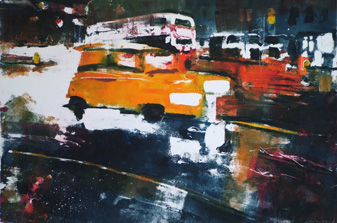 Baudrillard asks why people are drawn to New York. He suggests it is "an inner electricity ....a magical sensation of continuity and attraction for an artificial centrality." The city is a space of dreams, a hyperreality where the thrill of being crowded together heightens the senses. The city is the stage against which the small pyschodramas of life and death are played out. Nothing is quite real. Everything is possible. The streets at night, flooded by the sodium glare of car headlights and neon reflections of shops spilling onto wet pavements, are a filmic construct in which we become both participant and watchful observer. The city is both Utopian and Dystopian, the space onto which failure and dysfunction, longing and unfulfilled desire are projected.
Kate Downie has long been drawn to the urban. She explores, through paintings and monoprints places as diverse as New York, London and industrial Leith in her native Edinburgh. Her works are like glimpses through a travelling car window, postmortem fragments that unspool in front of the observer without narrative. Tenements blurred in a pool of sodium light. A street caught in a car's wing mirror like a filmic frame. Pizza men staring back across the street at the observer as they prepare their deliveries. The coloured bill boards at the Sugar Bond Warehouse that create a simulacra of life against the industrial grey. These works capture the danger, excitement and poetry of the modern city and stand as a metaphor for the fragmentation of contemporary life.
Sue Hubbard freelance writer for Time Out 1997